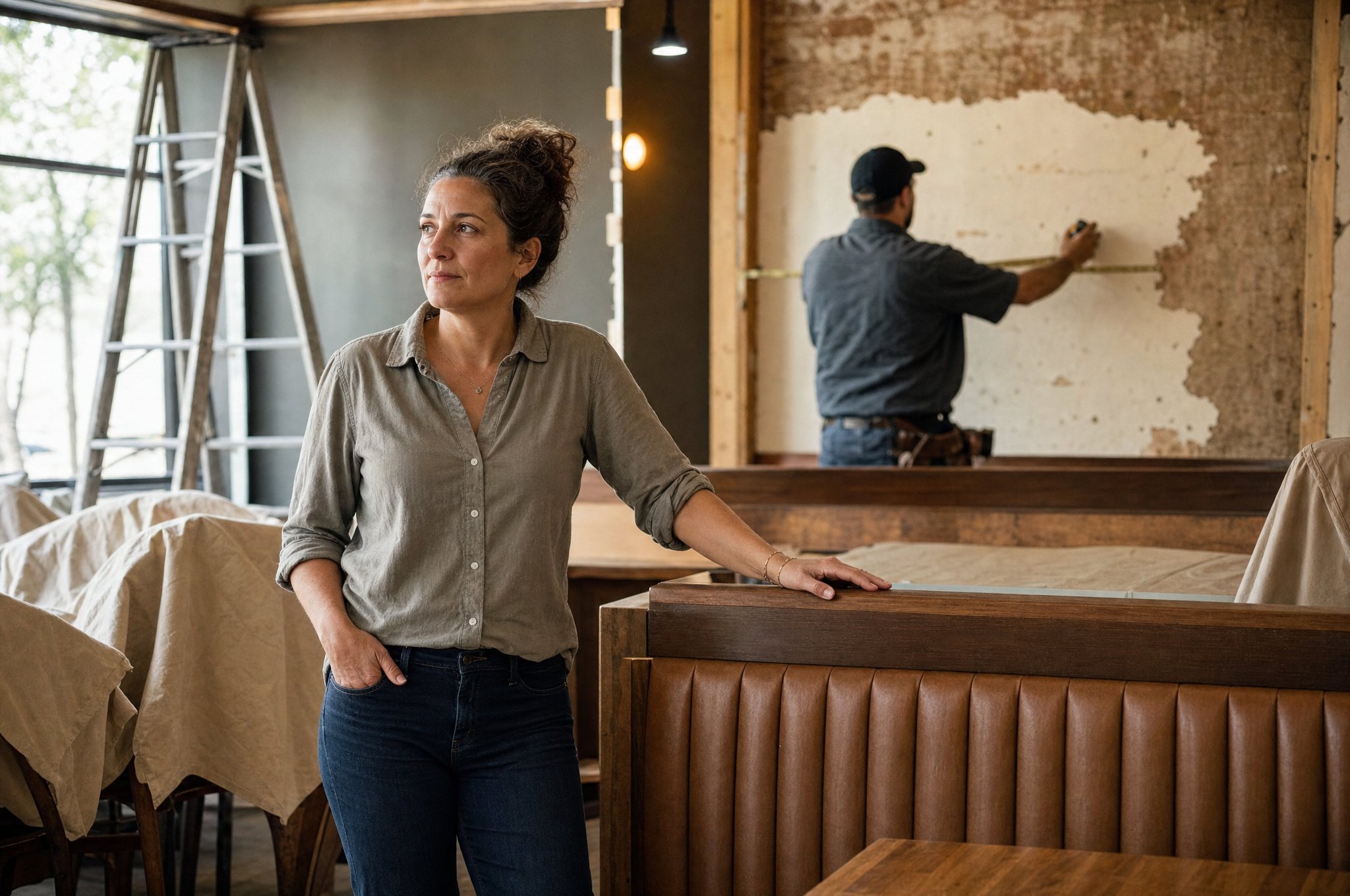

Say the contractor's bid came in at $150,000. The booths are torn, the hood is tired, and the bank balance has not moved since Tuesday. Before you sign anything, you need to know which money costs the least.
The short answer: the cheapest money for a remodel is money you do not borrow, meaning cash you can truly spare and an improvement allowance from your landlord. The cheapest borrowed money is a bank or SBA loan, priced from about 7% up to a 13% cap for a project this size. The most expensive is the fast money: cards near 21% a year, and POS loans whose fixed fee works out to roughly 23% to 43% a year when you repay in 12 to 6 months.
The fast lenders do get one thing right. They fund quickly and flex with your sales, which is worth paying for when the walk-in dies on a Friday. It is rarely worth that price for a dining room you will use for a decade. Below: the 7 ways to pay, ranked by true cost, a chart of the annual cost, the tax rule that cuts the real price, and a side by side table. Every rate is sourced.
Why a remodel is a financing decision first
A remodel is a long-lived asset, so the money should last as long as the work does. Paying for a ten-year dining room with six-month money is how a good remodel turns into a cash crunch. SBA builds this into its rules: per SBA's 7(a) terms, a loan for equipment or leasehold improvements generally runs up to 10 years, plus up to 12 months to finish the work, and real estate up to 25 years.
Lenders still want your signature. In the Federal Reserve Banks' 2026 Small Business Credit Survey, 59% of firms with debt had secured it with a personal guarantee. Small banks fully approved 57% of applicants, more than any other lender type. We cover why banks hesitate in why banks will not lend to restaurants. Opening a second location instead? Read our restaurant expansion financing guide.
The 7 options, ranked by true cost
True cost means what you pay to use the money each year: interest, fees, and what it takes from your cash cushion. The ranking is Build&Fund's, built on each option's published benchmark. Your own quotes decide the final order, so get at least two.
-
1Cash the business can spareNo interest, no fees. The real cost is a thinner cushion. Use cash only if payroll, rent, and a slow month are still covered after the deposit. Our restaurant working capital guide shows how to size that cushion.
-
2Your landlord's improvement allowanceNo interest up front. Landlords who fund improvements usually want a longer lease or higher rent in return, so the price lives in the lease. Ask at renewal, when you have the most to offer.
-
3A bank term loan or line of creditThe Kansas City Fed's Small Business Lending Survey put the median variable rate on new small business term loans at 7% at urban banks and 6.7% at rural banks in the second quarter of 2026.
-
4An SBA 504 loan, if you own the buildingSBA lists renovating existing buildings as an eligible 504 use, with 10, 20, and 25 year terms. The fixed rate is pegged above the 10-year Treasury, which was 4.88% on November 9, 2026, and SBA fees apply on top. Options 3 and 4 trade places with the day's rates, so price both.
-
5An SBA 7(a) loanFor $50,001 to $250,000, the SBA cap is prime plus 6.0 points. With prime at 7.00% (Federal Reserve H.15, November 9, 2026), that is a 13.0% maximum. Above $350,000 the cap is prime plus 3.0, or 10.0%. Add an upfront guaranty fee that SBA resets each fiscal year. Caps are ceilings; your lender may price lower.
-
6A business credit cardThe Fed's G.19 release put the average rate on credit card plans at commercial banks at 21.19% for the third quarter of 2026. That benchmark covers consumer cards; business card rates vary by issuer. Fine for chairs you pay off next month. Brutal for a full remodel.
-
7A POS loan or merchant cash advanceSquare's published loan help page uses the example of a $10,000 loan with a $1,300 fixed fee, repaid through a fixed percentage of daily card sales. The fee never changes no matter how fast you repay. By Build&Fund's calculation, that is about 23% a year over 12 months and about 43% over 6. Compare offers in our POS capital comparison.
What the money costs per year, side by side
Bank is the Kansas City Fed median. SBA is the cap for a $150,000 loan, not a typical quote. POS uses Square's published fee example.
Now run the $150,000 bid through it (Build&Fund calculation, standard amortization):
- Bank loan, 7%, 5 years: about $2,970 a month, about $28,200 in interest.
- SBA 7(a) at the 13.0% cap, 10 years: about $2,240 a month, but about $118,800 in interest.
- Credit card, 21.19%, 3 years: about $5,670 a month, about $54,000 in interest.
- POS loan: at the same 13% fee ratio as Square's example, a $19,500 fee whether you repay in 6 months or 12. Illustrative; your offer sets your fee.
The tax rule that cuts the real cost of a remodel
Most owners price the loan and forget the deduction. Illustrative math: at a 25% combined tax rate, deducting $150,000 in the year the work is placed in service saves about $37,500 in tax that year. Spread over 15 years, the same deduction is worth about $2,500 a year (Build&Fund calculation, simplified). Take these to your CPA:
-
1What countsPer IRS Publication 946, qualified improvement property is generally an improvement to the interior of a nonresidential building, made after the building was first placed in service. Enlargements, elevators, escalators, and the internal structural framework do not count.
-
2The 100% rulePer the IRS Instructions for Form 4562, qualified improvement property is 15-year property, and property with a recovery period of 20 years or less acquired after January 19, 2025 is eligible for a 100% special depreciation allowance. The IRS issued interim guidance on that permanent rule in Notice 2026-11.
-
3The Section 179 backupSection 179 can also cover qualified improvement property, plus roofs, HVAC, fire protection and alarm systems, and security systems.
-
4TimingDepreciation starts when the work is placed in service, not when you sign, so the opening date can decide the tax year. While you are with your CPA, ask about the payroll tax credits restaurants miss.
Restaurant renovation financing options compared
| Option | How you repay | What it costs | Paid from |
|---|---|---|---|
| Cash on hand | Nothing to repay | No interest; a thinner cushion | Your reserves |
| Landlord allowance | Through rent or a longer lease | No interest up front; priced into the lease | Rent |
| Bank term loan | Fixed monthly payments | Median 6.7% to 7% variable (Q2 2026) | Operating cash flow |
| SBA 504 (you own the building) | Monthly, over 10, 20 or 25 years | Fixed, pegged above the 10-year Treasury (4.88%), plus fees | Operating cash flow |
| SBA 7(a) | Monthly, up to 10 years for leasehold work | Up to 13.0% on $50,001 to $250,000, plus an upfront fee | Operating cash flow |
| Business credit card | Monthly minimums | About 21% (Fed card benchmark) | Operating cash flow |
| POS loan or MCA | A fixed share of daily card sales | Fixed fee; about 23% to 43% a year on Square's example | Daily card sales |
| Capital + Customers | Only as new diners come in and redeem food and beverage credit | No interest, no factor rate | New guests, never a daily card pull |
Read the "Paid from" column first. Every row above the last is repaid from money your restaurant already earns. The last row works differently. Funding comes through our capital partners in exchange for future food and beverage credit, and you repay only as new diners come in and redeem that credit. Not a percentage of the sales you already ring.
When borrowing for a remodel is the right call
- The payment fits your slowest month, not your average month.
- The remodel adds something you can count: seats, covers, or a higher check.
- The term of the money is at least as long as the life of the work.
- You still hold a cash cushion after the contractor's deposit.
Skip the loan if cash is already tight; fix that first with our guide to restaurant cash flow problems. Weighing fast money anyway? Read what a daily debit does to your account in 30 days first.
A remodel should bring in new guests. That is exactly why it can be funded by them. See every route in our restaurant funding guide, or keep reading for the one built on new diners.

The other way to fund growth: repay with new diners, not your sales
Build&Fund backs great restaurant operators with new customers through their doors and the capital to handle them. Through our capital partners, qualifying restaurants get access to $10,000 to $50,000+ in initial funding, in exchange for future food and beverage credit. You repay only as new diners come in and redeem that credit. Not a percentage of the sales you already ring. Not a daily card pull. Never a cash payment.
One document starts your review: your POS sales report. Decisions move fast, and approved operators are funded within days. For qualifying operators, second rounds can quickly scale to six figures. No credit check. No personal guarantee.
Who qualifies: $500K+ in annual sales and a 4.0+ Google rating. Every food and beverage establishment can qualify: full service, quick service, bars, and cafes.
-
1Confirm you clear the bar$500K+ in annual sales and a 4.0+ Google rating.
-
2Submit one documentYour POS sales report. No credit check, no personal guarantee.
-
3Fast decisionDecisions move fast. No weeks of back-and-forth.
-
4Funded within days$10,000 to $50,000+ to start, through our capital partners.
-
5Repay only as new diners redeem creditFood and beverage credit, never in cash.
-
6Scale as it proves outFor qualifying operators, second rounds can quickly scale to six figures.
Frequently Asked Questions