
Location one finally runs without you on the line every night. Sales are steady, the reviews are strong, and there is a space across town with a hood already in it. Then the money question hits, and almost every answer runs through the restaurant you already own: its bank account, its cash flow, or your signature.
Here is the honest short answer. Funding location two without betting location one does not mean zero risk. It means deciding, in writing, how much of location one goes on the table, and keeping the rest off it. Pay for the walls with slow, long-term money sized to what location one can carry. Finance equipment against the equipment. Keep location one's operating cash out of the drywall. Never put a buildout on an advance that drafts location one's card sales.
You will not be the first owner to sign your name to the deal. In the Federal Reserve Banks' 2026 Small Business Credit Survey report on employer firms, 59% of small firms with debt had secured it with a personal guarantee. Below: what the bank asks, what SBA money costs, and every option ranked by risk. Comparing every kind of restaurant money? Start with how to get funding for a restaurant.
What the bank actually asks of location one
The SBA 7(a) loan is the standard bank route for an expansion, and its rules are public. Its current rulebook, SOP 50 10 8.1, took effect October 1, 2026. Five rules matter.
Location one signs, too. When an existing business starts a new one in the same 3-digit NAICS industry code with identical ownership, and the two are co-borrowers, SBA treats it as a business expansion, not a new business. That label matters: SBA asks new businesses for more, including 15% down instead of 10% on a 504 loan. The price is that both restaurants are on the note.
You sign personally. Any individual who owns 20% or more must provide an unlimited full guaranty.
Above $350,000, your house can fill the gap. A Standard 7(a) loan, the kind above $350,000, must be fully secured by business fixed assets. If it falls short, the lender must take available equity in 20% owners' personal real estate. And leased buildouts make thin collateral: SBA's rulebook says leasehold improvements provide minimal collateral value.
Location one's cash flow carries the load. Debt service coverage must be at least 1.15, counting all business debt, including the new loan.
A leased buildout gets 10 years, not 25. Leasehold improvement loans cap at 10 years, plus up to 12 months to finish the work. Real estate gets 25.
- Rates are capped. On a loan above $350,000, the variable rate cannot exceed the base rate plus 3.0 points.
- Long terms. Generally 10 years for equipment and buildouts, 25 for real estate, on loans up to $5 million.
- Collateral is not everything. A loan must not be declined solely because collateral is inadequate.
What SBA expansion money costs at the rate caps
SBA caps 7(a) variable rates by loan size, pegged to prime: plus 6.5 points for $50,000 or less, 6.0 for $50,001 to $250,000, 4.5 for $250,001 to $350,000, and 3.0 above $350,000. With prime at 7.00% on October 23, 2026, per the Federal Reserve's H.15 release, those caps stood at 13.5%, 13.0%, 11.5% and 10.0%.
Take an illustrative location two in leased space: a $500,000 Standard 7(a) loan over 10 years at the 10.0% cap. The payment is about $6,608 a month, or $79,300 a year, and about $292,900 in interest over the life of the loan. SBA's fiscal 2027 upfront fee is 3% of the guaranteed portion at this size, and SBA guarantees up to 75% of loans above $150,000. That is $11,250, which lenders may pass to you (Build&Fund calculation).
Now the number that decides whether you get the loan. At 1.15 coverage, $79,300 a year of new debt service means showing about $91,200 a year of cash flow available for debt service, before any debt you already carry (Build&Fund calculation).
For scale: the National Restaurant Association's 2025 Restaurant Operations Data Abstract puts 2024 median income before taxes at 2.8% of sales for full service and 4.0% for limited service, or $56,000 and $80,000 at $2 million in sales. Lenders measure cash flow, which adds back depreciation and interest, so your number runs higher.

Every way to fund location two, ranked by what it puts at risk
Ordered from least exposure for location one to most.
-
1A landlord improvement allowanceThe landlord funds part of the buildout and expects it back through the lease, so compare total rent, not the allowance. And read the lease guaranty: a personal guarantee on a 10-year lease is a bet too.
-
2Equipment financingFinance the walk-in against the walk-in. If the equipment is the only collateral, a default risks the machine, not the business; get that in writing. IRS Rev. Proc. 2025-32 sets the 2026 Section 179 limit at $2,560,000, so ask your CPA about expensing it.
-
3An SBA 504 loan, if you are buying the buildingFixed-rate money for real estate and long-life equipment over 10, 20 or 25 years, pegged above the 10-year Treasury. You put in at least 10%, or 15% for a new business: $50,000 or $75,000 on a $500,000 project. It cannot fund working capital.
-
4An SBA 7(a) loanThe workhorse for a leased location: buildout, equipment and working capital in one loan. You pay for that flexibility with the rules above. Small banks gave the best odds in the Fed survey: 57% of their applicants were fully approved.
-
5An investorNo payment and no lien. You pay with a share of every distribution and any sale, for as long as they own it. We ran that math in giving up equity in your restaurant.
-
6Location one's cashNo interest, no paperwork, and riskier than it looks. Every dollar of reserves poured into drywall is a dollar location one cannot use for a slow month. When small firms hit trouble, 54% used the owner's personal funds, per the Fed survey.
-
7A merchant cash advance or POS loanThe fastest yes and the worst fit. Repayment comes out of location one's card sales while location two is still a construction site, and 60% of firms that borrowed from online lenders said costs ran higher than expected. Our POS capital comparison shows how holdbacks work.
Location two funding options, side by side
| Option | How you repay | What it costs | Paid from |
|---|---|---|---|
| SBA 7(a) loan | Monthly, up to 10 years for a leased buildout, 25 for real estate | Capped at prime plus 3.0 to 6.5 points (10.0% to 13.5% at a 7.00% prime), plus an upfront fee on the guaranteed portion | Both restaurants' cash flow, plus your personal guaranty |
| SBA 504 loan | Monthly, over 10, 20 or 25 years | Fixed rate pegged above the 10-year Treasury, at least 10% down | The building and the business |
| Equipment financing | Monthly over the life of the equipment | Set by the lender, with the equipment as collateral | Monthly cash flow |
| Investor equity | Never repaid. The investor owns a share until you buy it back | A share of every distribution and of any sale | Your profit and your exit |
| Merchant cash advance | Daily or weekly debit until a fixed payback is met | A factor rate sets the payback up front | Location one's daily card sales |
| Capital + Customers | Only as new diners come in and redeem food and beverage credit | No interest, no factor rate | New guests, never a daily card pull |
Read the last column first. Every other row is paid from cash your restaurants already produce or ownership you already have. That is the bet; put as little of it on the table as the project allows. Worried about the personal guarantee? Read our guide to business funding without a personal guarantee.
When the SBA route is the right call, and how to cap the bet
- Location one clears 1.15 coverage on its own history, after the new payment, with room to spare.
- The loan is sized to a signed contractor bid, not a hopeful budget.
- Location one keeps its operating reserve, untouched, through the build.
- The lender has put in writing what collateral it will take and whether a lien on your home is limited to the shortfall.
- The deal still works with the payment at the rate cap.
Skip it, or shrink it, when the plan only works if location two hits its projections in month three. A slow ramp plus a fixed payment is how location two starts drawing on location one. If the bank says no, read why banks won't lend to restaurants, and see restaurant working capital for bridge options.
Where Capital + Customers fits: not the walls. Through our capital partners, qualifying restaurants get $10,000 to $50,000+ in initial funding in exchange for future food and beverage credit, and you repay only as new diners come in and redeem that credit. It is not a daily card pull and never a cash payment, so it adds no draft to location one's bank account.
The other way to fund growth: repay with new diners, not your sales
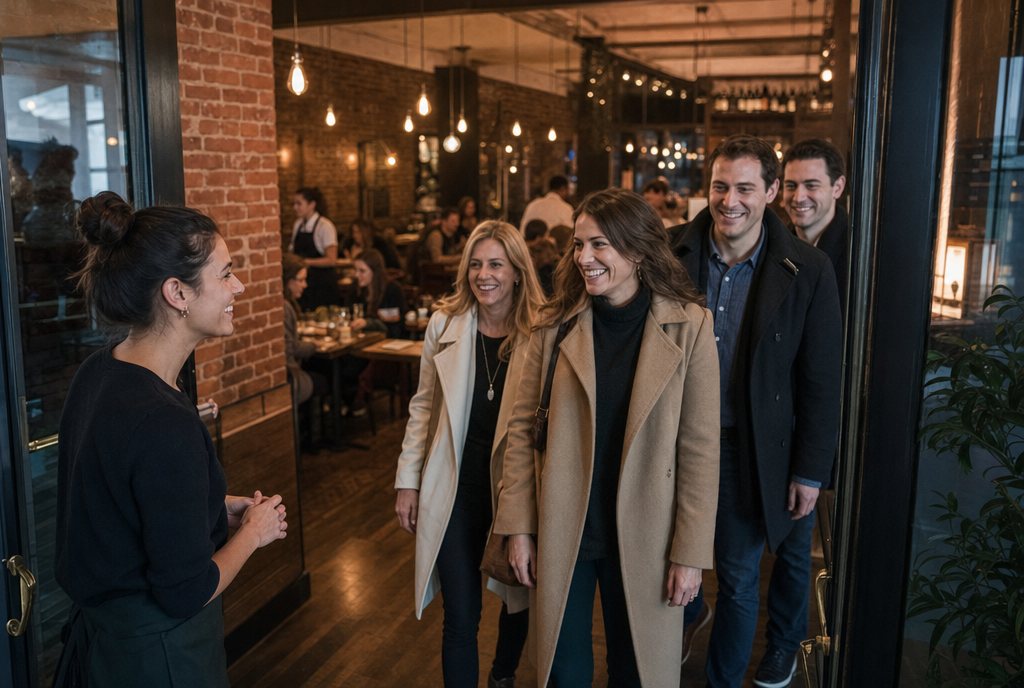
Build&Fund backs great restaurant operators with new customers through their doors and the capital to handle them. Through our capital partners, qualifying restaurants get access to $10,000 to $50,000+ in initial funding, in exchange for future food and beverage credit. You repay only as new diners come in and redeem that credit. Not a percentage of the sales you already ring. Not a daily card pull. Never a cash payment.
One document starts your review: your POS sales report. Decisions move fast, and approved operators are funded within days. For qualifying operators, second rounds can quickly scale to six figures. No credit check. No personal guarantee.
Who qualifies: $500K+ in annual sales and a 4.0+ Google rating. Every food and beverage establishment can qualify: full service, quick service, bars, and cafes.
-
1Confirm you clear the bar$500K+ in annual sales and a 4.0+ Google rating.
-
2Submit one documentYour POS sales report. No credit check, no personal guarantee.
-
3Fast decisionDecisions move fast. No weeks of back-and-forth.
-
4Funded within days$10,000 to $50,000+ to start, through our capital partners.
-
5Repay only as new diners redeem creditFood and beverage credit, never in cash.
-
6Scale as it proves outFor qualifying operators, second rounds can quickly scale to six figures.
Frequently Asked Questions