How to Get Business Funding Without a Personal Guarantee

Last month, a roofing contractor in Phoenix accessed $187,000 in business funding. Zero personal guarantee. No lien on his house. No spouse co-signing anything.
Meanwhile, his competitor across town, same revenue, same industry, same years in business, got declined for a $40,000 line of credit because his personal credit score dropped 47 points after a medical bill went to collections.
Same business fundamentals. Completely different outcomes.
The difference? One owner spent 18 months learning how to build business credit without personal guarantee requirements. The other kept applying for traditional loans that tied his family's financial future to every business decision.
If you're a small business owner who wants access to real capital without risking your personal assets, credit score, or peace of mind, this guide will show you exactly how strategic credit stacking works, who qualifies, and the specific steps to separate your business funding from your personal financial life.
Why Most Small Business Owners Can't Build Business Credit Without Personal Guarantee Requirements
Here's the uncomfortable truth most lenders won't tell you: the traditional funding system is designed to keep your personal assets on the hook.
Banks love personal guarantees. SBA loans require them. Most merchant cash advances bury them in the fine print. Even "business" credit cards from major issuers often report to your personal credit bureaus and tank your score if anything goes sideways.
According to recent lending data, over 80% of small business loans under $350,000 require some form of personal guarantee. That means your house, your savings, your retirement accounts, all exposed to business risk.
The consequences are real:
- Personal credit damage: Late business payments can drop your personal score 50-100 points, affecting your mortgage rate, car loan, and insurance premiums
- Asset exposure: A business failure doesn't just close your company. It can trigger personal bankruptcy and home foreclosure
- Spouse liability: In community property states, your partner's credit and assets may be at risk even if they're not involved in the business
- Limited future options: One default can lock you out of favorable lending terms for 7-10 years
The problem isn't that business owners are irresponsible. It's that most have never been shown the alternative path: building legitimate business credit that stands completely separate from personal finances.
Personal guarantees don't just create risk at the moment of default. They create ongoing stress that affects how you run your business, the risks you're willing to take, and ultimately, your growth ceiling.
How Strategic Credit Stacking Lets You Build Business Credit Without Personal Guarantee Exposure
Strategic credit stacking isn't a loophole or a hack. It's a methodical approach to establishing your business as a standalone creditworthy entity, one that qualifies for funding based on its own financial foundation rather than your personal credit score.
The IRS actually makes this separation possible. When you obtain an Employer Identification Number (EIN) under IRS regulations, you're creating a distinct tax identity for your business. This EIN becomes the foundation for building business credit that doesn't touch your personal credit reports.
Under the Fair Credit Reporting Act (15 U.S.C. § 1681), business credit bureaus like Dun & Bradstreet, Experian Business, and Equifax Business maintain completely separate files from consumer credit bureaus. Payments made by your business EIN to vendors who report to commercial bureaus build your business credit profile, not your personal one.
Here's what this looks like in practice:
A marketing agency owner we worked with started with $0 in available business credit. Over 14 months, she strategically opened vendor accounts, secured business credit cards that don't require personal guarantees, and built relationships with lenders who evaluate business fundamentals.
The result: $215,000 in available business credit across multiple funding sources, with $165,000 at 0% introductory APR for 12-21 months. Her personal credit score? Completely untouched by any of it.
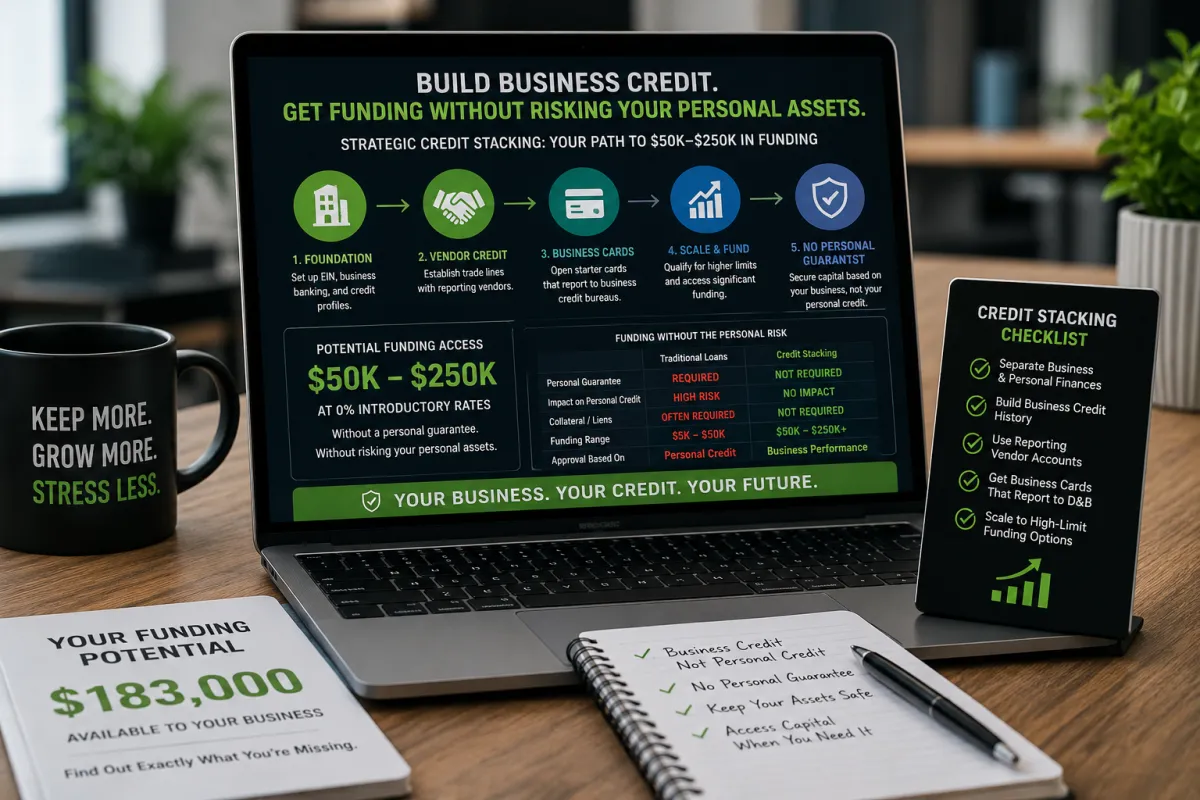
The key is sequencing. You don't walk into a bank and ask for $200,000 with no personal guarantee on day one. You build progressively, establishing vendor credit, then secured business cards, then unsecured cards, then lines of credit, each step creating the foundation for the next.
Quick question: Do you know how much hidden revenue your business is sitting on?
Through our credit stacking approach, qualified business owners access $50,000-$250,000 at 0% introductory rates without a personal guarantee.
Get Your Free Hidden Revenue ReportWho Qualifies to Build Business Credit Without Personal Guarantee Requirements
Strategic credit stacking works best for established businesses with real operational history, but you don't need perfect circumstances to start.
Review this qualification checklist:
- ✓Your business is registered as an LLC, S-Corp, or C-Corp (sole proprietors face more limitations)
- ✓You have an active EIN from the IRS
- ✓Your business has been operating for at least 6 months
- ✓You maintain a dedicated business bank account with regular deposits
- ✓Your business generates at least $10,000 monthly revenue
- ✓You have a business phone number and address separate from personal
- ✓You're willing to follow a 12-18 month credit building timeline
If you checked even one box, you are likely leaving money on the table.
The business owners who see the best results aren't necessarily the ones with the highest revenue or longest track record. They're the ones who start building business credit before they desperately need it.
The best time to build business credit without personal guarantee requirements was two years ago. The second best time is right now: before you need emergency capital and have no leverage.
The Costly Mistakes Business Owners Make When Seeking Funding Without Personal Guarantees
I've seen smart business owners torpedo their credit stacking potential with mistakes that seem minor but have major consequences. Here are the ones that hurt most:
Mistake #1: Applying for everything at once. Every credit application generates an inquiry. Too many inquiries in a short period signals desperation to lenders, even on the business side. Strategic stacking means spacing applications 30-60 days apart and targeting specific products in the right sequence.
Mistake #2: Ignoring vendor credit. Business owners skip straight to credit cards because vendor accounts feel small. But companies like Uline, Grainger, and Quill report to commercial bureaus. These "starter" accounts establish your business credit file and qualify you for larger opportunities. You cannot skip this step.
Mistake #3: Not separating finances completely. Using your personal credit card for business expenses, even occasionally, muddies your credit separation. Lenders look for clean boundaries between personal and business finances. One commingled account can disqualify you from no-personal-guarantee products.
Mistake #4: Choosing the wrong card products. Many "business" credit cards report to personal bureaus and require personal guarantees despite marketing language. You need products that explicitly report only to commercial bureaus and underwrite based on business revenue, not personal credit scores.
For a deeper dive into funding strategies that protect your personal assets while maximizing business capital, explore our Business Funding and Credit Stacking Program.
The difference between business owners who access $200,000 without personal guarantees and those who get declined for $20,000 often comes down to sequencing and product selection, not business fundamentals.
Your 90-Day Action Plan to Build Business Credit Without Personal Guarantee Exposure
Building business credit that doesn't require personal guarantees is a process, not an event. Here's the exact sequence that moves business owners from personally-guaranteed debt to standalone business funding:
- 1Establish Your Business Credit Foundation (Days 1-14)
Register with Dun & Bradstreet to get your DUNS number. It's free and required for most business credit applications. Verify your business information with Experian Business and Equifax Business. Ensure your business name, address, and phone number are consistent across all registrations. Open a dedicated business checking account if you haven't already, and make sure you have at least $5,000 in regular monthly deposits flowing through it.
- 2Open 3-5 Vendor Credit Accounts (Days 15-45)
Apply for net-30 accounts with vendors who report to commercial credit bureaus. Start with easier approvals: Uline, Grainger, Quill, and similar suppliers in your industry. Make small purchases and pay invoices early, before the due date when possible. Early payment accelerates your credit score improvement. Aim for at least $1,000 in reported trade line activity within the first 60 days.
- 3Apply for Starter Business Credit Cards (Days 46-75)
Target business credit cards that don't require personal guarantees and report only to commercial bureaus. Some options underwrite based on cash flow and business revenue rather than personal credit scores. Start with one application, wait for approval, then add a second card 30-45 days later. Keep utilization below 30% on each card to maximize credit score impact.
- 4Scale to Higher-Limit Products (Days 76-90 and Beyond)
With established vendor credit and 2-3 business credit cards reporting positive payment history, you qualify for higher-limit products. This includes business lines of credit in the $25,000-$100,000 range and premium business credit cards with $50,000+ limits. Each successful account strengthens your business credit profile for the next tier of funding.
- 5Work With a Credit Stacking Specialist
This is where working with a specialist pays for itself. A credit stacking expert knows which products approve at each stage, the exact application timing that maximizes approval odds, and how to structure your credit stack for maximum available capital. The difference between DIY credit building and guided credit stacking is often $50,000-$150,000 in additional approved funding.
What Is Your Business Leaving on the Table?
The business owners accessing $150,000 or more without personal guarantees aren't lucky. They built their business credit strategically before they needed it.
Every month you wait is a month your business could be building credit that doesn't put your family's financial security at risk.
Think about what changes when you can build business credit without personal guarantee requirements: You take calculated growth risks without lying awake wondering if a bad quarter could cost you your house. You negotiate from strength instead of desperation. You invest in opportunities when they appear, not six months later when the moment has passed.
The average business owner we work with discovers $47,000-$183,000 in funding capacity they didn't know they could access, at rates dramatically better than the merchant cash advances and high-interest loans they were considering.
Your next step isn't complicated. Find out exactly what funding your business qualifies for right now, without any impact to your personal credit score.
Find Out Exactly What You Are Missing
The Hidden Revenue Report shows where your business qualifies for recovery, savings, or capital. Takes less than 2 minutes and it is free.
Get Your Free Hidden Revenue ReportOr explore our Business Funding and Credit Stacking Program
Keep reading: How to Get Capital for Small Business After Bank Rejection