0% Business Funding Explained: Credit Stacking for SMBs

📅 May 2026 · ⏱ 7 min read · Build&Fund Advisory Team
Last spring, a plumbing company in Dallas needed $87,000 to purchase a second service van, hire two technicians, and expand into commercial accounts. The owner had strong personal credit, consistent revenue, and a decade of industry experience. Yet when he approached his bank for a traditional small business loan, he was offered terms that would have cost him over $31,000 in interest over five years. A merchant cash advance provider quoted him an effective APR exceeding 45%. Instead, he worked with a funding specialist who helped him secure $92,000 through 0% business funding credit stacking: multiple business credit lines acquired strategically during promotional periods. His total interest cost during the introductory window? Zero dollars. That Dallas plumber isn't an outlier. He represents a growing movement of savvy small business owners who've discovered that the traditional funding playbook is rigged against them, and that alternative capital strategies exist for those willing to learn the rules.
The True Cost of Traditional Small Business Financing
Most small business owners don't fully calculate what conventional financing actually costs them. When you factor in origination fees, closing costs, and compound interest, a seemingly reasonable 12% APR business loan can extract 40% or more of the borrowed principal over its lifetime. Merchant cash advances, marketed as quick and easy, routinely carry effective rates between 40% and 150% when expressed as annualized interest. For a restaurant owner borrowing $50,000 to renovate a dining room, or a retail shop financing seasonal inventory, these costs don't just eat into margins. They can eliminate profitability entirely, turning what should be a growth investment into a years-long debt trap.
The math becomes even more alarming when you examine opportunity cost. Every dollar paid in interest is a dollar that can't be reinvested into marketing, equipment, staff training, or inventory that generates revenue. A service business paying $800 monthly in loan interest effectively loses $9,600 annually that could fund a part-time employee, a targeted advertising campaign, or critical equipment upgrades. Multiply that across a typical five-year loan term, and the true cost of capital becomes staggering.
Why Traditional Lenders Make Growth So Expensive
Banks and conventional lenders aren't necessarily villains. They're operating within a risk model that penalizes small businesses by design. Without substantial collateral, years of audited financials, and often a personal guarantee that puts your home at risk, lenders perceive small business loans as high-risk propositions. To compensate for anticipated defaults across their portfolio, they charge rates that make profitable borrowing nearly impossible for the businesses that need capital most. The irony is that many small business owners with excellent personal credit, the kind of credit that would qualify them for premium consumer rates, find themselves facing predatory terms when they seek business financing.
This structural mismatch has driven the explosive growth of alternative lending, but not all alternatives serve the borrower's interest. Merchant cash advances, revenue-based financing, and other quick-approval products often exploit urgent capital needs with terms that would be illegal if applied to consumer loans. Small business owners, desperate to make payroll or seize time-sensitive opportunities, sign agreements they don't fully understand, only to discover they've committed to repayment structures that extract a third or more of their daily revenue. The system is designed to keep you borrowing, not to help you grow.
Your personal credit score, often 720 or higher, qualifies you for 0% introductory business credit that most entrepreneurs never think to pursue, simply because they've been conditioned to believe business funding must come with high interest attached.
How 0% Business Funding Through Credit Stacking Actually Works
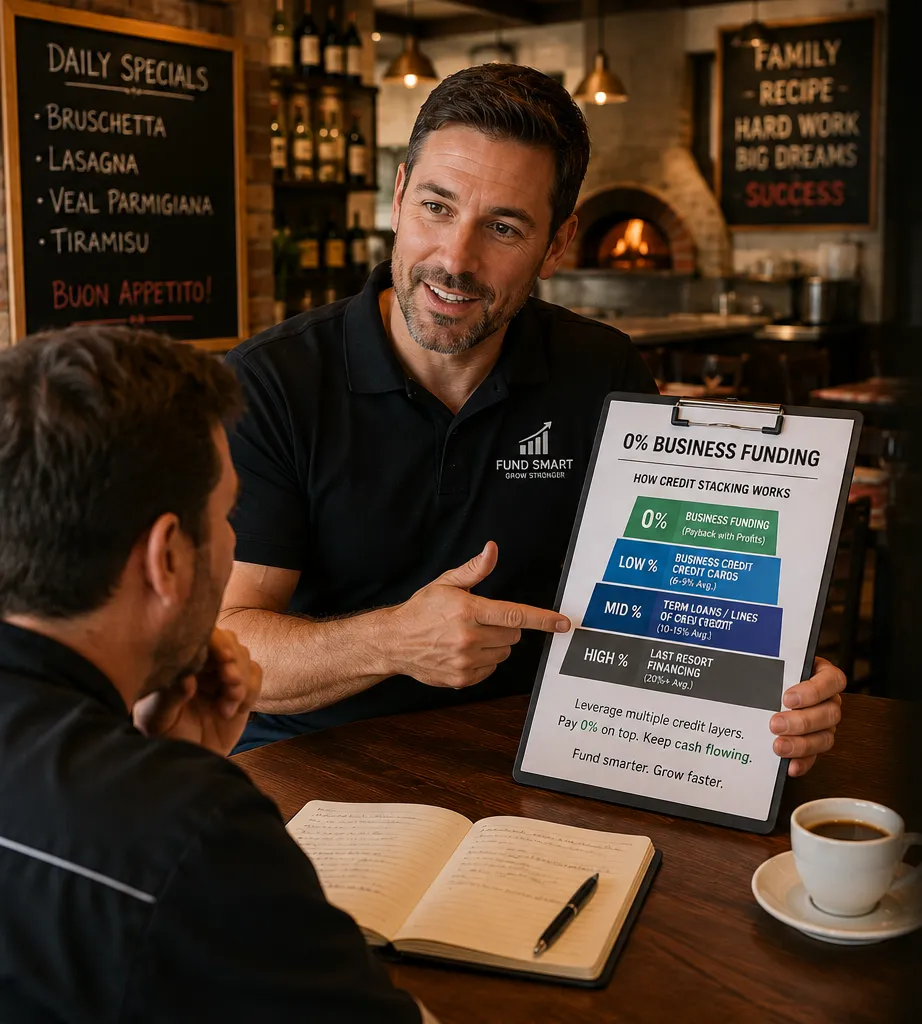
Credit stacking is the strategic acquisition of multiple business credit lines, typically during promotional 0% APR periods, to create a substantial pool of working capital without traditional loan interest. Unlike applying for a single large credit facility, which triggers intense scrutiny and often rejection, this approach leverages the fact that individual credit lines in the $10,000 to $50,000 range face significantly lower approval barriers. When executed properly with attention to timing, credit utilization, and issuer relationships, business owners can legitimately access $50,000 to $250,000 in total credit at zero introductory interest.
- 1Assess Your Credit Foundation
Before pursuing any credit stacking strategy, obtain your personal credit reports from all three bureaus and calculate your current utilization ratios. Ideal candidates have credit scores of 680 or higher, utilization below 30%, and no recent derogatory marks. Address any errors or disputes before beginning applications.
- 2Research Current 0% APR Offers
Business credit cards with introductory 0% periods typically range from 12 to 21 months. Identify issuers whose underwriting criteria align with your profile, and note the length of promotional periods, balance transfer options, and ongoing APR once the introductory period ends.
- 3Strategic Application Timing
Submit applications within a compressed window, typically 14 days, to minimize the impact of multiple hard inquiries on your credit score. Many scoring models treat inquiries within this period as a single event when shopping for credit.
- 4Deploy Capital With Purpose
Use acquired credit for planned business investments that generate revenue or reduce costs: equipment, inventory, marketing campaigns, or hiring. Avoid using 0% capital for operational expenses that don't produce returns.
- 5Establish Repayment Discipline
Divide your total balance by the number of months in your shortest promotional period, then set up automatic payments exceeding that amount. The goal is full repayment before any interest accrues, maintaining the true 0% cost of capital.
What to Look for in a Credit Stacking Program
Not all approaches to credit stacking deliver equal results. Whether you pursue this strategy independently or work with a funding specialist, certain criteria separate effective programs from those that create more problems than they solve.
- ✓ Transparent fee structure with no hidden costs or percentage-of-funding charges
- ✓ Credit monitoring and optimization before application submission
- ✓ Strategic timing guidance to minimize credit score impact
- ✓ Issuer relationship knowledge to maximize approval rates and credit limits
- ✓ Post-funding support including utilization management and repayment planning
- ✓ No requirement for personal guarantees on business credit lines
- ✓ Clear documentation of promotional period end dates and ongoing terms
Access $50,000 to $250,000 at 0% Introductory Rates
Build&Fund's Business Funding and Credit Stacking Program helps qualified business owners secure growth capital without high-interest debt or personal guarantees. Our specialists handle issuer relationships, application timing, and credit optimization so you can focus on running your business.
Learn More →Critical Mistakes That Derail Credit Stacking Success
Even well-intentioned business owners can undermine their credit stacking strategy through common missteps that transform interest-free capital into a liability.
- Ignoring the promotional period clock. Every 0% APR offer has an expiration date, and the moment it passes, balances convert to standard rates, often 20% or higher. Business owners who treat these lines as indefinite funding sources face sudden, substantial interest charges that eliminate the strategy's entire advantage.
- Maxing out utilization across all lines. Even if you're approved for $150,000 in total credit, utilizing more than 30% of available credit damages your credit score and reduces future funding options. Strategic deployment means using what you need, not everything available.
- Funding operations instead of investments. Zero-percent capital works when it finances activities that generate returns: equipment that increases capacity, inventory that sells at margin, marketing that acquires customers. Using credit stacking to cover payroll shortfalls or ongoing operational deficits simply delays a reckoning while adding debt.
Comparing True Cost of Capital: Funding Options for Small Businesses
Understanding how credit stacking compares to traditional funding alternatives requires examining the actual dollar cost on a typical $75,000 capital deployment. The differences are substantial enough to determine whether a growth investment generates profit or becomes a net loss for your business.
The visualization above illustrates why funding source selection matters as much as the underlying business decision. A restaurant investing $75,000 in kitchen equipment faces dramatically different outcomes depending on how that capital is acquired. With properly executed credit stacking, the investment cost is limited to the equipment value itself. With a merchant cash advance, that same equipment effectively costs over $103,000, a premium that could fund an additional major purchase or a year of marketing.
Credit stacking isn't about gaming the system. It's about understanding how strategic credit acquisition can replace predatory lending as your primary growth capital source. For small business owners with strong personal credit profiles, the opportunity to access substantial funding at zero introductory interest represents one of the most significant financial advantages available today. The key lies in execution: proper timing, disciplined utilization, and rigorous repayment planning that ensures promotional periods are used fully before standard rates apply.
The Dallas plumber who secured $92,000 without interest didn't stumble into that outcome. He worked with specialists who understood issuer relationships, application timing, and credit optimization. Eighteen months later, his additional van and technicians had generated over $340,000 in new revenue. That is profit that would have been substantially reduced had he accepted the bank's original loan terms or, worse, a merchant cash advance. Your business deserves the same strategic approach to 0% business funding credit stacking that sophisticated operators have been using for years.
Discover Capital You Didn't Know You Could Access
Most small business owners qualify for significantly more 0% funding than they realize. Our Hidden Revenue Recovery analysis identifies not just credit stacking opportunities, but multiple overlooked capital sources across your entire operation.
Get Your Free Hidden Revenue Analysis →Or explore our Business Funding and Credit Stacking Program