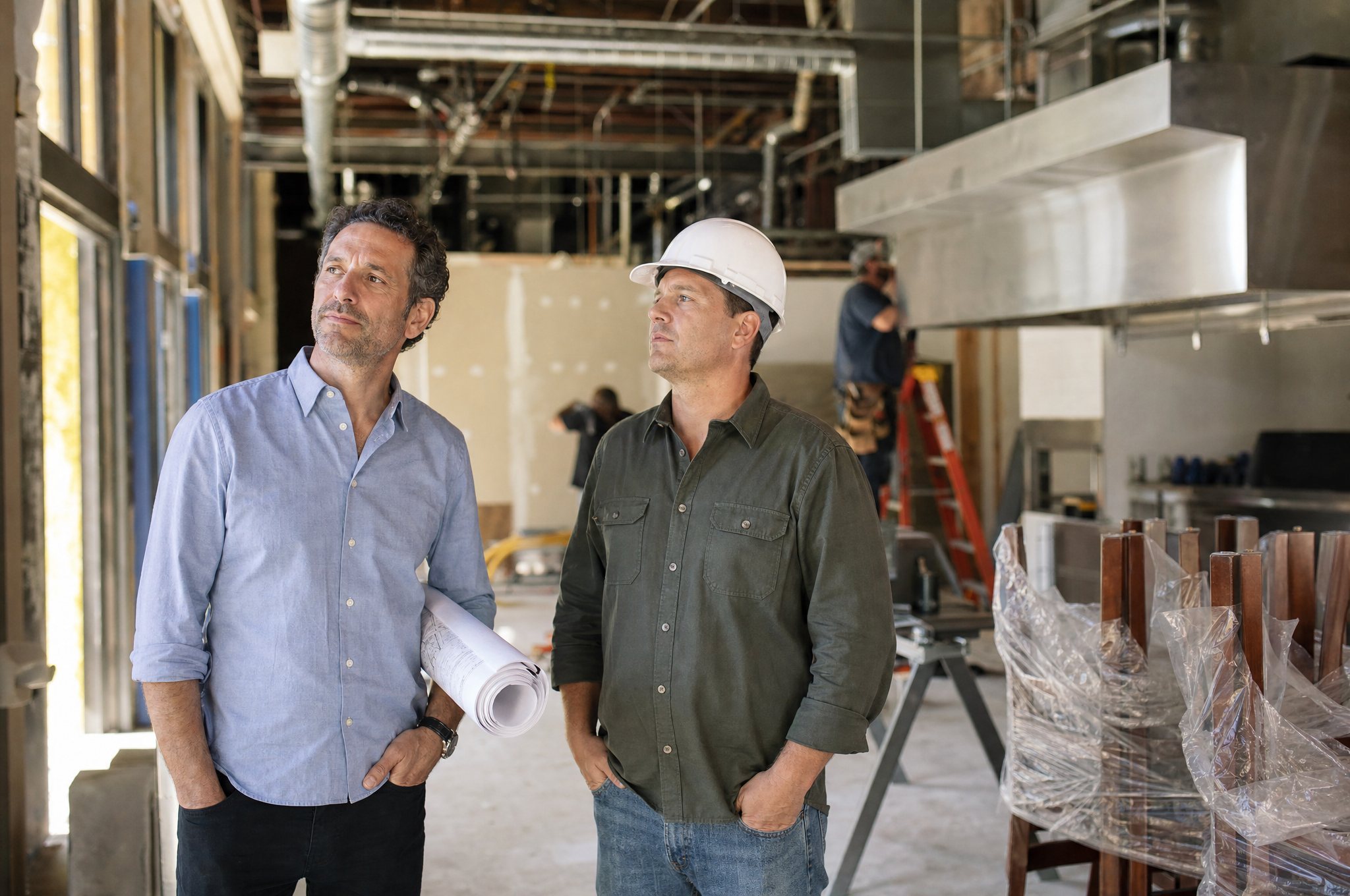

You priced the buildout. You priced the hood, the walk-in, and the chairs still wrapped in plastic. The number that decides whether location two makes it is the one with no contractor attached: the cash to run the place for 90 days while the room fills up.
Here is the honest short answer. There is no single price for a second location, but the published budgets agree on its shape. A franchise budget for a coffee cafe of about 1,800 square feet runs $482,500 to $743,000 all in. At the midpoint, buildout and equipment take about 76% of the money and the 90-day cash line gets about 4% (Build&Fund calculation from the Just Love Coffee Cafe franchise investment table). Location one does give you a real head start: a trained team to borrow, vendors who know you, and systems that already work. It does not make the walls any cheaper.
Below: every line with real ranges, why your old invoices are stale, and the reserve math most budgets skip. To pay for it, see funding location two without betting location one.
The best line-by-line budgets are public. Almost nobody reads them.
Independent operators rarely publish their opening budgets. Franchisors have to disclose theirs. The FTC Franchise Rule requires a table titled YOUR ESTIMATED INITIAL INVESTMENT covering real estate, equipment and construction, opening inventory, deposits, and licenses.
It also requires a line most owners never write down: additional funds to carry the business before opening and through an initial period. In the rule's own words, "A reasonable initial period is at least three months or a reasonable period for the industry."
You are not buying a franchise, so skip the franchise fee and the royalty. Nearly every other line on those tables is a line on yours.
- They are itemized. Buildout, equipment, signage, design fees, inventory, deposits, insurance, and payroll each get a line.
- They split cash before opening from cash after. Momma Goldberg's lists $10,000 to $50,000 of working capital before operations begin and another $25,000 to $50,000 for the first 3 months.
- They state the footprint. Just Love Coffee Cafe says its cafes average around 1,800 square feet, so buildout converts to a cost per square foot.
Every line in a second-location budget, with real ranges
Ranges below come from two published tables: a coffee cafe of about 1,800 square feet (Just Love Coffee Cafe) and a sandwich deli (Momma Goldberg's). Your concept, city, and lease will move every number. The structure will not.
-
1Buildout (leasehold improvements)$250,000 to $400,000 for the cafe and $90,000 to $400,000 for the deli. At 1,800 square feet, the cafe range works out to about $139 to $222 per square foot (Build&Fund calculation). Hungry Howie's 2025 disclosure shows $196,500 to $273,500 for a 1,300 to 1,600 square foot shop, about $123 to $210 per square foot, and notes the figure is before any landlord allowance.
-
2Equipment, furniture, and fixtures$110,000 to $170,000 for the cafe, supplies included. The deli lists $95,000 to $150,000 for equipment and fixtures, plus $12,000 to $22,000 for furnishings.
-
3Design, engineering, and permits$16,000 to $18,000 in architectural, engineering, and accounting fees for the cafe. The deli lists $6,500 to $15,000 for architecture and $1,500 to $5,000 for permits and licenses. A liquor license is its own line, and its cost varies widely by state.
-
4Rent, deposits, and insurance before you openThe cafe budgets 1 to 2 months of rent at $3,500 to $15,000 and $4,000 to $6,000 for insurance. The deli lists $3,000 to $50,000 for security deposits, utility deposits, impact fees, and other prepaid expenses.
-
5Opening inventory$9,000 to $15,000 in pre-opening inventory and supplies for the cafe; $5,000 to $15,000 for the deli.
-
6Pre-opening payroll and launch marketingThe cafe budgets 2 months of employee salaries at $7,000 to $10,000 and $5,000 for grand opening marketing.
-
7The 90-day cash reserve$20,000 to $30,000 for the cafe. $25,000 to $50,000 for the deli, on top of its pre-opening cash. The rest of this post is about this line.
Sources: Just Love Coffee Cafe franchise investment table; Momma Goldberg's Item 7 table (posted 2025); Hungry Howie's 2025 FDD, Item 7. Each range is that franchisor's estimate for its own concept.
What it really costs: the walls and the gear take three quarters
Line up the cafe table's midpoints and the shape is plain. Buildout and equipment come to $465,000 of a $612,750 midpoint total, about 76%. The 90-day reserve is $25,000, about 4% (Build&Fund calculation).
Your location-one invoices are stale
If you built location one before 2020, do not budget off its invoices. The producer price index for goods that go into nonresidential construction stood at 115.5 in February 2020 and 185.009 in October 2026, up about 60%. It rose about 11% in the last 12 months alone (BLS data published by the Federal Reserve Bank of St. Louis; October 2026 is preliminary; Build&Fund calculation). It tracks materials only, so treat it as a warning and get fresh bids.
The 90-day math most budgets skip
Each franchisor sizes its reserve from its own system's experience. Your second location has your name but none of its own regulars yet. Size the reserve to your own numbers.
Take an illustrative full-service location two planned at $1.5 million a year, or $375,000 in its first 90 days. At the National Restaurant Association's 2024 full-service medians (food and non-alcohol beverage at 32.0% of sales, labor at 36.5%, occupancy at 5.7%), those 90 days carry about $278,250 in food, labor, and rent alone (Build&Fund calculation from the 2025 Restaurant Operations Data Abstract). Utilities, marketing, repairs, and debt service come on top. More on sizing cash in our restaurant working capital guide.
Sales cover most of that if they arrive on plan. The reserve covers what happens if they do not. The crew is scheduled and rent is due whether guests come or not, so every 10 points that sales run below plan for those 90 days takes about $25,500 out of the cash you expected: 10% of $375,000, minus the 32% that would have gone to food (Build&Fund calculation, labor and rent held at plan). In this example, food, labor, and rent alone are covered only once sales reach about 62% of plan.
Put that next to the same NRA data: median full-service pre-tax income was 2.8% of sales, or $42,000 a year on $1.5 million. One slow first quarter at location two can cost more than a full year of median profit at a restaurant that size. That is one way a healthy location one ends up profitable but broke.
Price pre-opening payroll, too. Train a crew of 30 for 40 hours each at the BLS average hourly earnings for restaurant production and nonsupervisory staff, $20.39 in September 2026 (preliminary), and payroll runs $24,468. Add the employer's 6.2% Social Security and 1.45% Medicare taxes and it is about $26,340 before a single guest pays (Build&Fund calculation; BLS; IRS Topic 751). Borrowing trainers from location one cuts that bill, but those hours come out of location one's schedule.
How owners cover the 90-day gap, side by side
Most owners pay for the walls with long-term money and cover the first 90 days with whatever is left, which usually means location one carries it.
| Option | How you repay | What it costs | Paid from |
|---|---|---|---|
| Location one's cash | Nothing to repay | No interest, but location one loses its cushion | Location one's reserves |
| SBA 7(a) working capital | Monthly principal and interest | The lender's rate, under SBA caps that run higher on smaller loans | Both restaurants' cash flow |
| Business line of credit | Interest on what you draw | Set by the lender | Monthly cash flow |
| Merchant cash advance | Daily or weekly debit until a fixed payback is met | A factor rate sets the payback up front | Daily card sales |
| Capital + Customers | Only as new diners come in and redeem food and beverage credit | No interest, no factor rate | New guests, never a daily card pull |
Read the last column first. Every row above the last is paid from cash or sales your restaurants already produce. The whole point of a reserve is that location one never has to bail out location two. If an advance is on the table, first read what an MCA does to a restaurant bank account in 30 days.
When a second location pencils out
- You have fresh bids for the buildout, not location one's old invoices.
- The 90-day reserve is funded and parked before construction starts, separate from the buildout budget.
- You know the share of plan at which food, labor, and rent are covered, and what you cut if sales sit below it.
- Location one runs without you on the line, and its own reserve stays untouched.
- You have a plan to fill the new room that does not depend on deep discounts. Our breakdown of restaurant customer acquisition cost by channel shows what each one costs.
If the bids come in high and the reserve does not fit, wait. Growing location one first is often the cheaper move, and our guide to restaurant renovation financing ranks seven ways to pay for it.
The other way to fund growth: repay with new diners, not your sales
Build&Fund backs great restaurant operators with new customers through their doors and the capital to handle them. Through our capital partners, qualifying restaurants get access to $10,000 to $50,000+ in initial funding, in exchange for future food and beverage credit. You repay only as new diners come in and redeem that credit. Not a percentage of the sales you already ring. Not a daily card pull. Never a cash payment.
One document starts your review: your POS sales report. Decisions move fast, and approved operators are funded within days. For qualifying operators, second rounds can quickly scale to six figures. No credit check. No personal guarantee.
Who qualifies: $500K+ in annual sales and a 4.0+ Google rating. Every food and beverage establishment can qualify: full service, quick service, bars, and cafes.
-
1Confirm you clear the bar$500K+ in annual sales and a 4.0+ Google rating.
-
2Submit one documentYour POS sales report. No credit check, no personal guarantee.
-
3Fast decisionDecisions move fast. No weeks of back-and-forth.
-
4Funded within days$10,000 to $50,000+ to start, through our capital partners.
-
5Repay only as new diners redeem creditFood and beverage credit, never in cash.
-
6Scale as it proves outFor qualifying operators, second rounds can quickly scale to six figures.
Frequently Asked Questions