How to Eliminate Credit Card Processing Fees: Complete Guide

📅 April 2026 · ⏱ 7 min read · Build&Fund Advisory Team
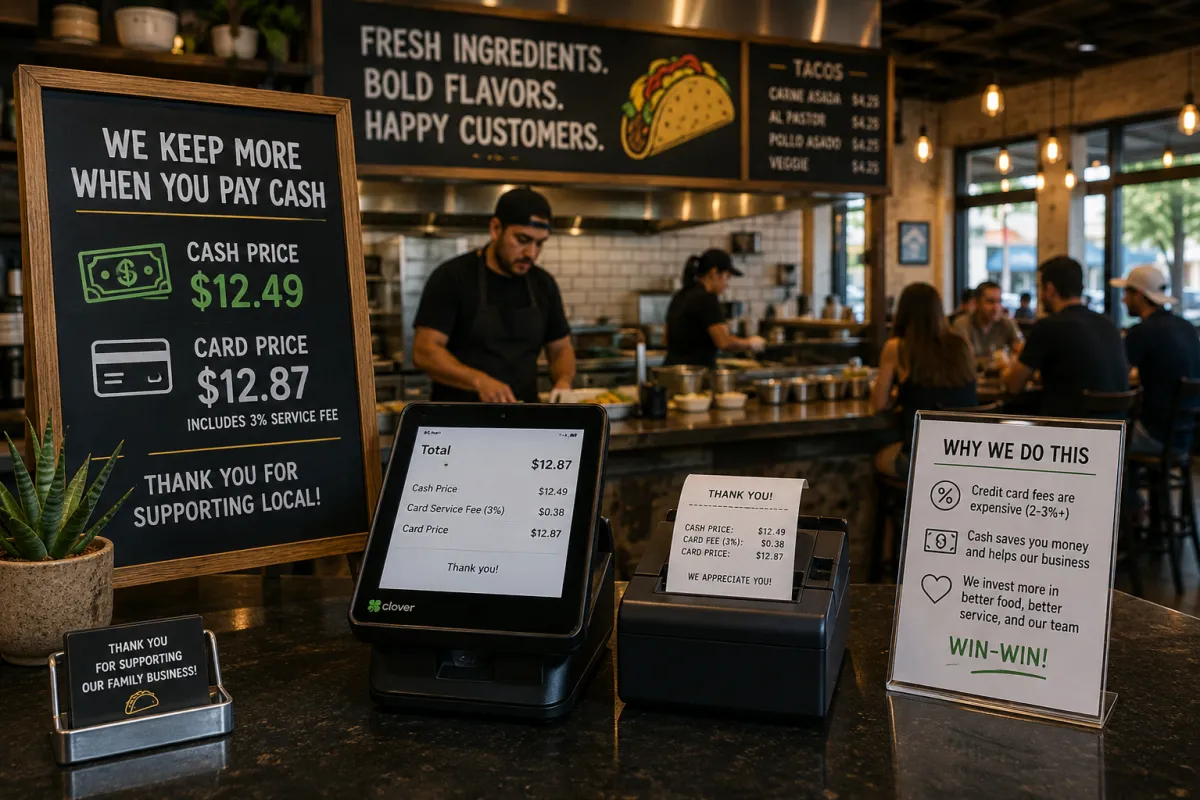
Maria runs a busy taco restaurant in Austin. Last month, she processed $62,000 in credit card transactions. When she finally sat down with her accountant, the number that jumped off the page wasn't her food cost or labor. It was the $2,108 she paid in credit card processing fees. That's $25,296 per year vanishing before she can reinvest a single dollar into her business. If you've ever wondered how to eliminate credit card processing fees, you're not alone. Thousands of small business owners are discovering that these costs aren't inevitable. They're negotiable, reducible, and in many cases, entirely avoidable.
The Real Cost of Credit Card Processing for Small Businesses
Credit card processing fees operate like a silent tax on every transaction your business completes. The standard rate hovers between 2.5% and 3.5% of each sale, but that headline number masks the true complexity. Your actual costs include interchange fees paid to the card-issuing bank, network assessment fees collected by Visa or Mastercard, and processor markup: the profit your payment company extracts from every transaction. Add monthly statement fees, PCI compliance charges, batch fees, and equipment rental costs, and the real percentage climbs even higher.
For small business owners operating on thin margins, these fees represent more than an inconvenience. They represent the difference between growth and stagnation. A retail store processing $40,000 monthly in card sales surrenders roughly $1,200 to $1,400 every month. A service contractor billing $75,000 monthly could be losing over $2,500. These aren't abstract numbers. This is the money that would otherwise fund a marketing campaign, a new employee, or equipment that improves your service.
Why Small Businesses Overpay on Payment Processing
The payment processing industry thrives on complexity and opacity. Most business owners sign up with a processor when they first open, accept whatever rate they're offered, and never revisit the decision. Meanwhile, their card mix shifts toward premium rewards cards and corporate cards that carry higher interchange rates. Hidden fees accumulate: downgrades for transactions that don't meet certain criteria, cross-border charges when a customer's card was issued overseas, and mysterious "service fees" that appear without explanation. The processors understand that most owners are too busy running their businesses to audit every line item on a monthly statement filled with cryptic codes and abbreviations.
The pricing model itself often works against you. Many processors use tiered or bundled pricing that obscures the true cost of each transaction type. They quote you a low "qualified" rate but then classify the majority of your transactions as "mid-qualified" or "non-qualified," each carrying progressively higher fees. Without transparent interchange-plus pricing, you have no way to know whether you're paying a fair markup or subsidizing their profit margins at your expense.
Most small businesses are paying 15-30% more in processing fees than necessary due to opaque pricing models, hidden charges, and failure to renegotiate rates as transaction volume increases.
How to Eliminate Credit Card Processing Fees: A Step-by-Step Approach
- 1Audit Your Current Processing Statements
Before making any changes, you need to understand exactly what you're paying. Request the last six months of processing statements and calculate your effective rate: total fees divided by total volume. If that number exceeds 2.5%, you're likely overpaying. Look for recurring charges you don't recognize, and note any fees labeled as "non-compliance," "batch," or "statement" charges. These are often negotiable or eliminable with the right processor relationship.
- 2Understand Your Pricing Model Options
Demand interchange-plus pricing from any processor you work with. This model separates the non-negotiable interchange fees from the processor's markup, giving you complete visibility into what you're actually paying. Avoid tiered pricing and flat-rate models unless your average transaction size is very small. For most businesses, interchange-plus delivers the lowest effective rate and the greatest transparency.
- 3Implement a Cash Discount or Dual Pricing Program
The most effective way to eliminate processing fees entirely is through a compliant cash discount program. Under this model, you post your cash price as the standard and add a clearly disclosed service fee for card payments. The customer sees both prices and makes an informed choice. When they choose to pay by card, the fee covers your processing cost. When they pay cash, you keep every dollar. This approach is legal in all 50 states when properly implemented and disclosed.
- 4Optimize Your Transaction Practices
Simple operational changes can reduce your costs significantly. Always use card-present transactions when possible: swiped or tapped cards qualify for lower interchange rates than manually keyed entries. Settle your batch daily to avoid downgrade fees. Ensure your POS system captures all required data fields for B2B transactions, which can reduce commercial card interchange by 0.5% or more. Address matching and CVV verification also help you qualify for better rates.
- 5Negotiate and Renegotiate Regularly
Your processing relationship shouldn't be a set-it-and-forget-it arrangement. As your volume grows, your leverage increases. Contact your processor annually to request rate reviews. If they won't budge, use competing quotes as negotiating tools. Many processors will reduce markups by 10-20% rather than lose a growing account. The five minutes you spend making that call could save thousands annually.
What to Look for in a Fee-Elimination Solution
- ✓ Full compliance with card network rules and state regulations
- ✓ Clear, customer-friendly signage and receipt disclosure
- ✓ Transparent interchange-plus pricing with no hidden fees
- ✓ POS equipment that supports dual pricing automatically
- ✓ No long-term contracts or early termination penalties
- ✓ Dedicated support for implementation and staff training
- ✓ Monthly statements you can actually understand
- ✓ Integration with your existing accounting and POS systems
Stop Paying Processors to Accept Your Customers' Money
Build&Fund's Cash Discount Merchant Processing program helps restaurants, retailers, and service businesses eliminate processing fees entirely, compliantly and transparently. Our team handles setup, signage, and staff training so you can focus on running your business.
Learn More →Common Mistakes When Trying to Reduce Processing Costs
- Confusing surcharging with cash discounting. While both can offset fees, they have different legal requirements. Surcharging is prohibited in some states and requires specific disclosures. Cash discount programs, when structured correctly, are legal everywhere and face fewer restrictions. Using the wrong terminology or implementation method can expose you to compliance issues and card network penalties.
- Choosing a processor based solely on the quoted rate. A processor advertising 1.5% means nothing if they classify 70% of your transactions at higher tiers or bury you in monthly fees. Always calculate your all-in effective rate based on actual statements, not quoted rates. The cheapest advertised option frequently costs more than transparent interchange-plus pricing.
- Failing to train staff on the new pricing model. Customer experience matters. If your team can't confidently explain why there's a cash price and a card price, you'll face confusion, complaints, and potentially lost sales. Invest time in training before you launch any fee-elimination program. A well-informed staff turns a potential friction point into a non-issue for most customers.
The Financial Impact of Eliminating Processing Fees
Understanding the numbers helps clarify why this matters so much for small business sustainability. The savings scale directly with your card volume, meaning the more successful your business becomes, the more you lose to processors, unless you take action. Businesses that implement cash discount programs or negotiate aggressive interchange-plus rates typically recover 2-3% of their gross card revenue immediately.
For a business processing $50,000 monthly in card transactions, eliminating fees returns roughly $18,000 annually to the bottom line. That's not revenue. That's pure profit recovery. It's the equivalent of generating $180,000 in new sales at a 10% profit margin. When you frame fee elimination as a revenue opportunity rather than an administrative task, the urgency becomes clear.
Taking Control of Your Payment Processing Costs
Every swipe, tap, and online checkout quietly transfers money from your register to payment processors: money that should be funding your next hire, your equipment upgrade, or your own paycheck. Learning how to eliminate credit card processing fees isn't about finding loopholes or cutting corners. It's about understanding a system designed to extract maximum profit from businesses too busy to fight back, and choosing not to participate in that extraction.
The strategies outlined here work. Cash discount programs are transforming the economics of small business across industries from restaurants to auto repair shops to medical practices. Transparent pricing models are replacing predatory tiered structures. And business owners who take fifteen minutes to audit their statements are discovering thousands in recoverable revenue hiding in plain sight. The question isn't whether you can afford to address this. It's whether you can afford not to.
Keep reading: How to Reduce Processing Fees at Your Restaurant
Find Out How Much Revenue You're Losing to Hidden Fees
Most small business owners don't realize how much money disappears to processing fees, payroll inefficiencies, and unclaimed tax credits. Our free Hidden Revenue Recovery analysis identifies exactly where your money is going, and how to get it back.
Get Your Free Hidden Revenue Analysis →Or explore our Cash Discount Merchant Processing