How Restaurants Can Reduce Processing Fees and Keep Revenue

📅 May 2026 · ⏱ 7 min read · Build&Fund Advisory Team
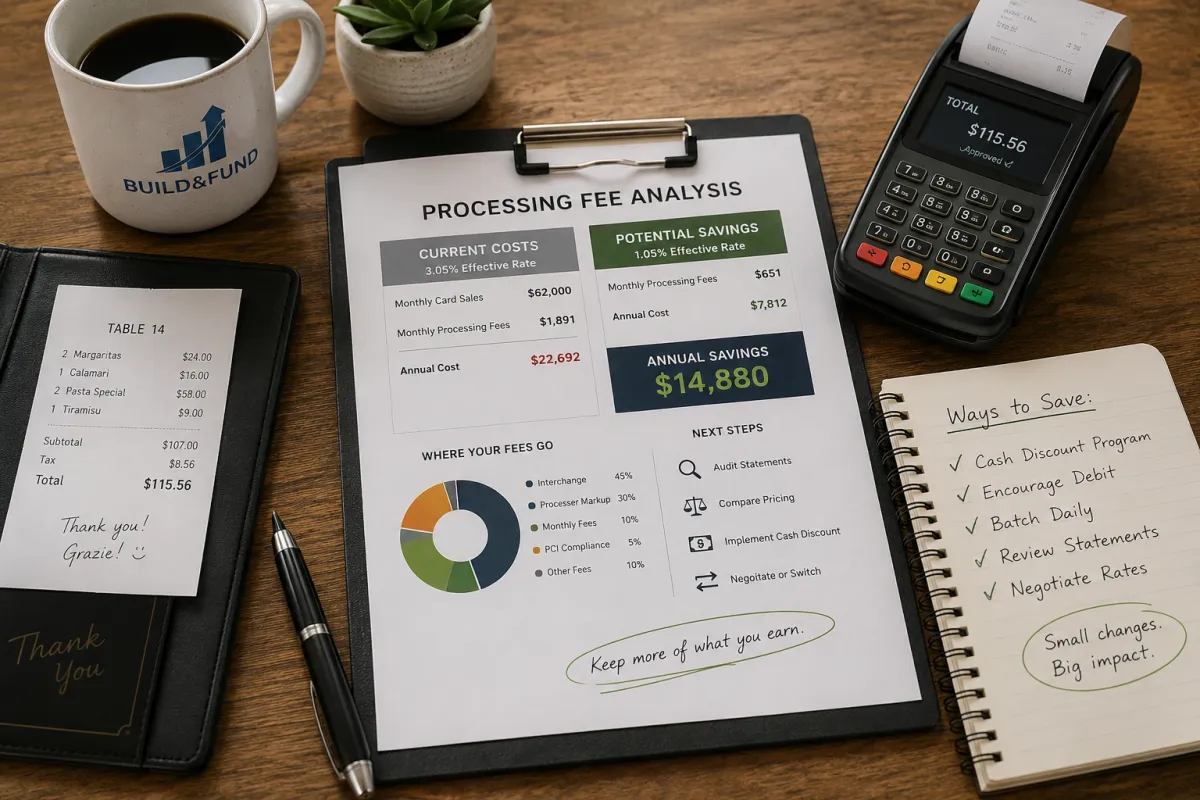
Maria runs a family-owned Italian bistro in Austin that pulls in roughly $62,000 per month in credit card sales. She thought her 2.9% processing rate was competitive—until she sat down with her accountant and realized she was hemorrhaging $1,798 every single month to card processors. That's $21,576 per year. Enough to hire another line cook. Enough to finally upgrade the patio seating. Enough to fund an entire marketing campaign. Instead, it vanished into a line item she barely understood. If you're a restaurant owner watching your margins shrink while your card fees climb, you're not alone—and the good news is that you can reduce processing fees at your restaurant without overhauling your entire operation.
The Real Cost of Credit Card Processing for Restaurants
Restaurants operate on notoriously thin margins—typically between 3% and 9% net profit. When processing fees consume 2.5% to 3.5% of every transaction, they're not just an expense; they're a direct competitor for your bottom line. A restaurant doing $50,000 per month in card sales hands $1,500 to $2,000 to processors every month. Scale that out, and you're looking at $18,000 to $24,000 annually—money that never touches your bank account, never pays your staff, and never improves your customer experience.
The restaurant industry faces unique challenges that amplify these costs. High transaction volumes, tips that inflate processing totals, and the prevalence of premium rewards cards (which carry higher interchange rates) all compound the problem. According to recent industry data, U.S. businesses collectively paid more than $187 billion in card processing fees in a single recent year—and restaurants absorbed a disproportionate share of that burden. Many owners assume these fees are fixed costs of doing business. They're not. They're negotiable, reducible, and in some cases, eliminable.
Why Restaurants Overpay on Card Processing
The payment processing industry thrives on complexity. Your monthly statement likely contains dozens of line items with names like "authorization fees," "batch fees," "PCI compliance fees," and "statement fees"—each one quietly extracting value from your business. Most restaurant owners never received training in payment processing. You learned to manage food costs, labor, and inventory. Nobody taught you to decode a merchant statement, so processors have little incentive to make it transparent. The result? Inflated markups that can add $800 to $4,000 or more to your annual costs, depending on your volume and the aggressiveness of your provider.
Interchange rates—the base fees set by card networks like Visa and Mastercard—are relatively standardized. But the markup your processor adds on top varies wildly. Some providers advertise low rates but bury fees in the fine print. Others lock you into long-term contracts with early termination penalties. And because switching processors feels complicated, many restaurant owners simply absorb the cost year after year, assuming it's unavoidable.
That knowledge gap is one of the most expensive blind spots a restaurant can have—and closing it could mean the difference between struggling and scaling.
Step-by-Step: How to Reduce Processing Fees at Your Restaurant
- 1Audit Your Current Statements
Before you can reduce costs, you need to understand them. Pull your last three months of merchant statements and identify every fee you're being charged. Look for markups above interchange, monthly minimums, PCI non-compliance fees, and any charges labeled "miscellaneous" or "other." Many restaurant owners discover they're paying for services they never use or fees that were quietly added after signup.
- 2Understand Your Pricing Model
Processors typically use one of three pricing structures: flat-rate, tiered, or interchange-plus. Flat-rate pricing (like 2.9% + $0.30) is simple but often expensive for high-volume restaurants. Tiered pricing bundles transactions into "qualified" and "non-qualified" categories, which processors can manipulate. Interchange-plus pricing shows you the exact interchange rate plus a transparent markup—it's generally the most honest model and often the cheapest for restaurants processing significant volume.
- 3Implement a Cash Discount or Dual Pricing Program
One of the most effective strategies to reduce processing fees at your restaurant is implementing a cash discount program. Under this model, you set your menu prices to include card processing costs, then offer a discount to customers who pay with cash. This approach is legal in all 50 states and allows you to effectively pass processing costs to card users while rewarding cash customers. Done right, it can eliminate your processing fees entirely.
- 4Encourage Debit Over Credit
Debit card transactions typically carry lower interchange rates than credit cards—especially signature-based rewards cards. Train your staff to mention debit as an option, and consider whether your POS system prompts PIN entry by default. The savings on each transaction are small, but they compound significantly over thousands of monthly transactions.
- 5Batch Transactions Daily
Failing to batch (settle) your transactions within 24 hours can result in higher interchange rates. Most POS systems can be set to auto-batch at the end of each business day. This simple configuration change costs nothing and prevents unnecessary rate increases on every delayed transaction.
- 6Negotiate or Switch Providers
Processors expect attrition, which means they often have room to negotiate—especially with established restaurants that demonstrate loyalty and consistent volume. Request a rate review, present competing quotes, and ask specifically about removing junk fees. If your current provider won't budge, a compliant switch to a better provider is simpler than most owners assume.
What to Look for in a Restaurant-Friendly Processor
- ✓ Interchange-plus pricing with transparent markup disclosure
- ✓ No long-term contracts or early termination fees
- ✓ Cash discount or dual pricing program options built into the platform
- ✓ PCI compliance assistance included at no extra charge
- ✓ Next-day funding availability for improved cash flow
- ✓ Restaurant-specific POS integration without proprietary hardware lock-in
- ✓ Dedicated support familiar with high-volume, tip-heavy environments
- ✓ Clear monthly statements without hidden or bundled fees
Stop Giving Away Your Margins to Card Processors
Build&Fund's Cash Discount Merchant Processing helps restaurants legally eliminate credit card fees while maintaining a seamless customer experience. Keep the revenue you've earned—without raising prices or frustrating guests.
Learn More →Common Mistakes Restaurant Owners Make With Processing Fees
- Assuming all processors are the same. The difference between a predatory processor and a transparent one can mean thousands of dollars annually. Just because you've "always used" a certain provider doesn't mean you're getting a fair deal. Loyalty rarely gets rewarded in this industry.
- Ignoring the statement because it's confusing. Processors count on your overwhelm. Every month you skip reviewing your statement is another month of potential overcharges going unnoticed. Set a calendar reminder to review fees quarterly at minimum.
- Fearing customer backlash from cash discount programs. When implemented correctly—with clear signage and staff training—cash discount programs rarely generate complaints. Customers understand that businesses have costs. Many actually appreciate the transparency and the option to save by paying cash.
Processing Fee Savings by Restaurant Volume
The impact of reducing your effective processing rate becomes dramatic as volume increases. A restaurant processing $30,000 monthly at a 3% effective rate pays $900 in fees; dropping to a 1% effective rate (through cash discounting or negotiation) saves $600 monthly. At $75,000 in monthly volume, that same reduction saves $1,500 per month—$18,000 annually. The following visualization illustrates potential annual savings across different monthly card volumes when reducing your effective rate by just two percentage points.
Take Control of Your Restaurant's Processing Costs
Credit card processing fees don't have to be a fixed drain on your restaurant's profitability. By auditing your statements, understanding your pricing model, and exploring options like cash discount programs, you can dramatically reduce processing fees at your restaurant—often without changing your POS system or disrupting daily operations. The restaurants that thrive in tight-margin environments aren't just great at food and service; they're disciplined about protecting revenue at every turn.
The first step is understanding exactly how much you're losing today. Most restaurant owners are stunned to discover the true cost once they see the numbers clearly. Don't let another month of unnecessary fees slip by while you focus on everything else.
Discover How Much Revenue You're Losing to Hidden Fees
Most restaurant owners underestimate their processing losses by 30% or more. Our free Hidden Revenue Analysis shows you exactly where your money is going—and how to get it back.
Get Your Free Hidden Revenue Analysis →Or explore our Cash Discount Merchant Processing