How Restaurant Owners Save on Payroll Taxes Beyond Tips

📅 April 2026 · ⏱ 7 min read · Build&Fund Advisory Team
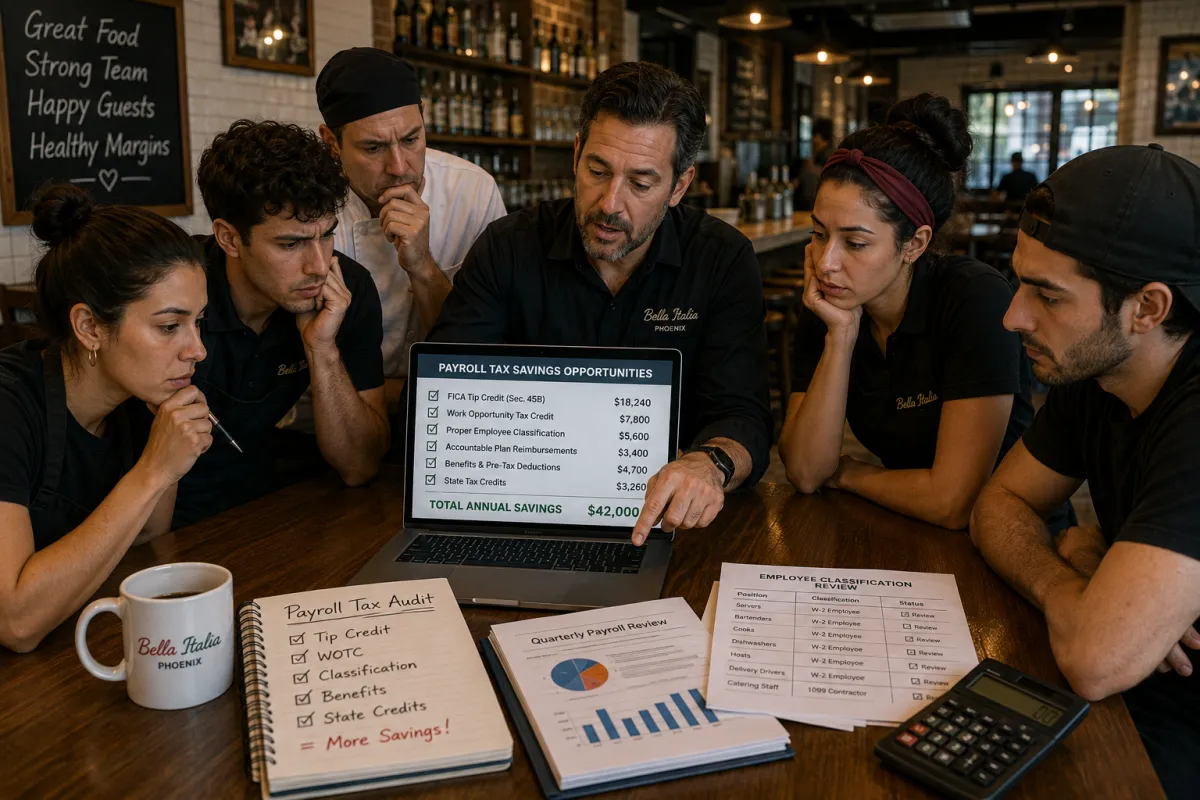
A family-owned Italian restaurant in Phoenix was doing everything right with their FICA tip credit. They reported tips accurately, filed on time, and recovered roughly $18,000 annually from Section 45B. But when they finally agreed to a full payroll audit, they discovered another $31,000 in annual savings they'd been missing: money that had nothing to do with tips at all. The owner told us he felt sick thinking about the years he'd left that cash on the table. If you're a restaurant operator who's already maximized your tip credit and wondering what else is out there, this guide shows you exactly how restaurant owners save on payroll taxes using strategies that go far beyond what your current accountant has probably mentioned.
The Real Cost of Incomplete Payroll Tax Strategy
Most restaurant owners understand the basics: you pay FICA taxes on wages, you can claim the tip credit, and you need to stay compliant with reporting requirements. What they don't realize is that payroll tax optimization is a discipline unto itself, one that most general accountants aren't trained in. The restaurant industry operates on notoriously thin margins, typically between three and nine percent. When you're fighting for every point of profitability, leaving money in the payroll tax system is the equivalent of buying premium ingredients and throwing half of them in the trash.
The problem compounds over time. A restaurant with twenty-five employees paying an average of $400 per month in unnecessary payroll taxes doesn't just lose $4,800 per year. They lose the compounding effect of that capital: money that could have funded a kitchen upgrade, covered a slow season, or padded an emergency fund. Over five years, that single oversight costs more than many owners spend on their entire point-of-sale system. And the truly frustrating part? These savings are legal, established, and available to any restaurant owner willing to look beyond the obvious.
Why Most Restaurant Owners Miss These Savings
The restaurant industry presents unique payroll challenges that create blind spots. You're dealing with tipped employees, varying shift lengths, seasonal fluctuations, and often multiple pay rates for the same worker depending on their role. Your bookkeeper is focused on keeping you compliant, making sure taxes get paid on time and reports get filed correctly. Tax strategy is a different function entirely, and it requires someone who understands both the restaurant industry's quirks and the full landscape of available credits, deductions, and classification opportunities.
There's also a knowledge gap in the market. Many restaurant owners learn about the FICA tip credit from their peers or their accountant, and they assume that's the extent of restaurant-specific payroll tax relief. They don't know to ask about work opportunity tax credits, research and development credits for menu innovation, or the proper classification strategies that can shift tax burden without changing actual compensation. The information exists, but it's scattered across IRS publications, tax court rulings, and industry-specific guidance that most operators simply don't have time to study.
Compliance and optimization are two different disciplines. Your payroll provider keeps you legal, but a payroll tax specialist finds the money you're legally entitled to keep.
How Restaurant Owners Save on Payroll Taxes: A Step-by-Step Approach
- 1Audit Your Current Employee Classifications
Review every position in your restaurant for proper classification. Are your delivery drivers correctly categorized? What about your catering coordinator who works both hourly shifts and manages events? Misclassification doesn't just create compliance risk. It can mean you're paying more employer taxes than necessary. A proper classification review often reveals opportunities to restructure roles in ways that benefit both the business and the employee.
- 2Maximize the Work Opportunity Tax Credit
The WOTC provides federal tax credits for hiring employees from specific target groups, including veterans, long-term unemployment recipients, and individuals from empowerment zones. Restaurants have high turnover by nature, which means more hiring, and more opportunities to capture these credits. The key is implementing a screening process during hiring that identifies eligible candidates without slowing down your recruitment. WOTC is one of several payroll tax credits most owners miss.
- 3Evaluate Your Benefits Structure for Tax Efficiency
Certain benefits reduce your taxable payroll base while providing real value to employees. Health insurance premium contributions, qualified transportation benefits, and dependent care assistance all lower the wages subject to payroll taxes. If you're paying these costs anyway, structuring them properly can reduce your FICA liability on every dollar that shifts from taxable wages to qualified benefits. Structuring this correctly is a Section 125 cafeteria plan, covered in our complete guide.
- 4Implement Accountable Plan Reimbursements
When employees use personal vehicles for catering deliveries, purchase supplies, or incur other business expenses, an accountable plan lets you reimburse them tax-free. Without a proper plan, those reimbursements get treated as taxable wages, meaning you pay employer FICA on money that's really just returning costs to the employee. Setting up an accountable plan requires documentation, but the payroll tax savings accumulate quickly.
- 5Review State-Specific Credits and Incentives
Beyond federal programs, most states offer their own employment tax credits. These might target job creation in specific industries, hiring from particular demographics, or investment in workforce training. Many restaurant owners focus exclusively on federal taxes and miss state programs worth thousands annually. A state-by-state review often uncovers credits that have gone unclaimed for years.
- 6Reconcile Your Payroll Records with Your Tax Filings
It sounds basic, but disconnects between payroll systems and actual tax filings are surprisingly common in restaurants. Tips get reported one way in the POS system and another way on payroll reports. Overtime calculations vary between systems. These discrepancies can mean you're paying more than you owe or, worse, creating audit exposure. Clean reconciliation is the foundation of any advanced tax strategy.
What to Look for in Your Current Payroll Setup
- ✓ WOTC screening integrated into your hiring process for every new employee
- ✓ Written accountable plan for employee expense reimbursements
- ✓ Benefits structured to maximize pre-tax deductions for both parties
- ✓ Regular reconciliation between POS tip reports and payroll tax filings
- ✓ State employment tax credits reviewed and claimed annually
- ✓ Proper documentation for all contractor relationships
- ✓ Quarterly review of employee classifications as roles evolve
- ✓ Section 45B FICA tip credit calculated and claimed on corporate returns
Stop Leaving Money in the Tax System
Our Payroll Tax Savings Program identifies every credit, deduction, and optimization strategy available to your restaurant. Most clients discover savings they never knew existed.
Learn More →Common Mistakes That Cost Restaurant Owners Thousands
- Treating all service charges as tips. Mandatory service charges, like automatic gratuity on large parties, aren't legally considered tips. They're treated as regular wages, which means different reporting requirements and different tax treatment. Confusing the two creates compliance issues and can cause you to miscalculate your FICA tip credit, often leaving money on the table.
- Ignoring the timeline for tax credits. Many tax credits, including WOTC, have strict timing requirements. You can't retroactively claim WOTC for an employee you hired six months ago if you didn't complete the certification paperwork within the required window. Implementing systems before you need them is the only way to capture every available credit.
- Assuming your payroll provider handles optimization. Payroll companies are in the business of processing paychecks and filing required taxes. They're not tax strategists. Relying on them to identify savings opportunities is like expecting your line cook to also handle your marketing. Each function requires specialized expertise.
Payroll Tax Savings by Restaurant Size
The savings potential scales dramatically with your employee count. Understanding where your operation falls helps set realistic expectations for what a comprehensive payroll strategy can recover.
These figures represent the combined impact of FICA tip credits, WOTC, proper classification, benefits structuring, and state-specific programs. Smaller operations often see the highest percentage improvement relative to their payroll costs, while larger restaurants benefit from the sheer volume of transactions and hiring activity that creates optimization opportunities.
The restaurant industry will always operate on tight margins. Food costs fluctuate, labor markets shift, and customer preferences evolve in ways you can't control. But your payroll tax liability is one area where proactive strategy consistently produces measurable results. Every dollar you recover goes directly to your bottom line: no additional sales required, no extra covers needed. For operators who've already mastered the tip credit and are ready to go deeper, the opportunities are substantial and waiting.
Find Out What You're Missing
Most restaurant owners we audit discover five-figure annual savings hiding in their payroll setup. A free analysis takes minutes and shows you exactly where your money is going.
Get Your Free Hidden Revenue Analysis →Or explore our Payroll Tax Savings Program